
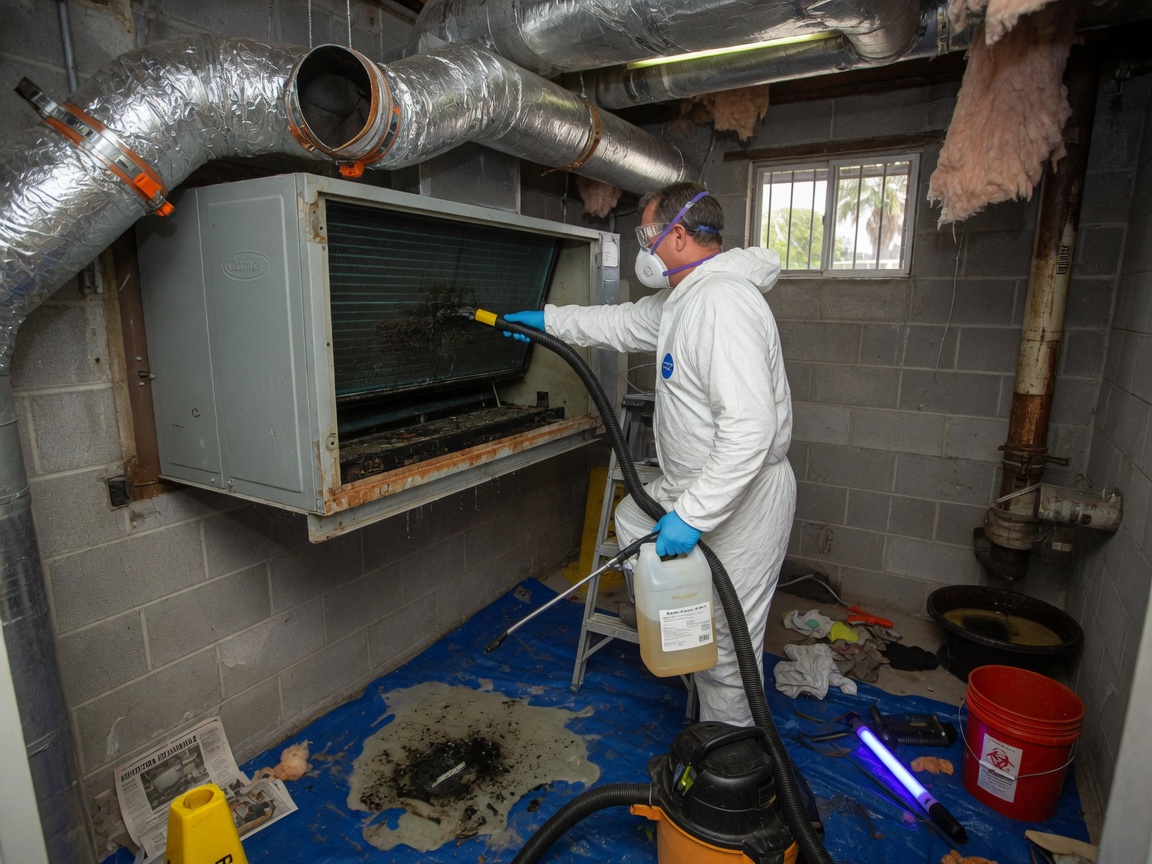
Houston's subtropical climate brings hot, humid summers that accelerate bacterial growth in HVAC ducts after an unattended death. In neighborhoods like the Heights and Montrose, many homes built before 1970 have original ductwork with seams and insulation that trap fluids and tissue residue, requiring full disassembly rather than simple fogging. Technicians must isolate the system early to prevent cross-contamination into living spaces, especially when return vents sit near bedrooms or kitchens.
River Oaks and Midtown properties often feature multi-zone systems tied to older attics where high humidity combines with decomposition fluids to create hidden mold colonies along coil surfaces. Standard household cleaners fail against protein-based residues that bond to metal and flex duct; enzymatic agents followed by HEPA vacuuming and antimicrobial rinses are needed. Access panels in tight attic spaces around Sugar Land and Pearland add time because technicians must work around existing insulation without disturbing settled particulates.
Downtown high-rises and Katy subdivisions present different constraints with shared rooftop units serving multiple units. Contamination can migrate through common plenums, so negative air machines and sealed containment become essential before any cleaning begins. Post-clean verification includes swab testing at supply registers to confirm removal of biological material before the system returns to service.
Technician insight
In Houston, the thing that catches most people out with HVAC System Decontamination is how quickly summer humidity drives fluids into flex duct seams in 1960s Heights bungalows; once that happens, simple fogging never reaches the trapped material and the odor returns within days.
Montrose Bungalow Duct Contamination
A 1962 single-story home in Montrose had an unattended death in the master bedroom with fluids reaching the nearby return vent. We found residue inside the original flex duct and on the attic-mounted air handler. The team isolated the system, removed saturated insulation, performed enzymatic cleaning, and replaced the affected duct runs. Airflow testing confirmed clean output before the family returned.
HVAC System Decontamination Services We Offer
✓Ductwork Biohazard Removal
Full disassembly and cleaning of supply and return ducts contaminated by decomposition fluids in single-family homes.
✓Coil and Blower Decontamination
Enzymatic treatment and rinsing of evaporator coils and blower assemblies to remove protein residues that cause persistent odors.
✓Attic Duct Insulation Replacement
Removal of saturated insulation in older Heights and Montrose attics followed by installation of new material after system cleaning.
✓Multi-Zone System Isolation
Sealing and separate treatment of zoned systems common in River Oaks and Midtown properties to prevent cross-unit contamination.
✓Post-Remediation Airflow Testing
Verification of restored airflow and swab sampling at registers to confirm biohazard removal before homeowner re-entry.
HVAC System Decontamination Cost in Houston, TX
| Service | Typical Range | What Affects It |
|---|---|---|
| Initial HVAC Assessment | $250–$450 | Higher in multi-story Montrose or Heights homes with limited attic access. |
| Full Duct Cleaning And Treatment | $1,200–$2,800 | Varies with linear feet of duct and whether insulation replacement is required. |
| Coil And Blower Service | $600–$1,100 | Increased when heavy residue reaches the evaporator in older River Oaks systems. |
| Verification Swab Testing | $300–$500 | Required for insurance documentation in Harris County properties. |
Ranges are typical for Houston, TX and confirmed with an exact written quote before any work starts.
How it works
- 1
Site Assessment
Technicians inspect the HVAC layout, locate all access points, and map contamination spread in the specific Houston home.
- 2
Containment Setup
Negative air machines and plastic barriers isolate the system from living areas to stop aerosolized particles from moving through the house.
- 3
Cleaning And Treatment
Ducts are vacuumed with HEPA equipment, coils receive enzymatic application, and all surfaces are rinsed and dried using dehumidification suited to Houston humidity.
- 4
Verification And Reassembly
Swab tests confirm removal of biological material, insulation is replaced where needed, and the system is returned to normal operation.
Pricing
Cost depends on system size, home age, and extent of contamination; quotes provided during Mon–Fri 8am–6pm or Sat 9am–2pm hours.